FocusOn Healthcare
  • Women's Health
  • Bone Health
  • Urology
  • Cardiology
  • Head Pain
  • Hepatology
  • Dermatology
  • Gastroenterology
  • Neurology
  • Oncology
  • Specialties:
  • Women's Health
  • Bone Health
  • Urology
  • Cardiology
  • Head Pain
  • Hepatology
  • Dermatology
  • Gastroenterology
  • Neurology
  • Oncology

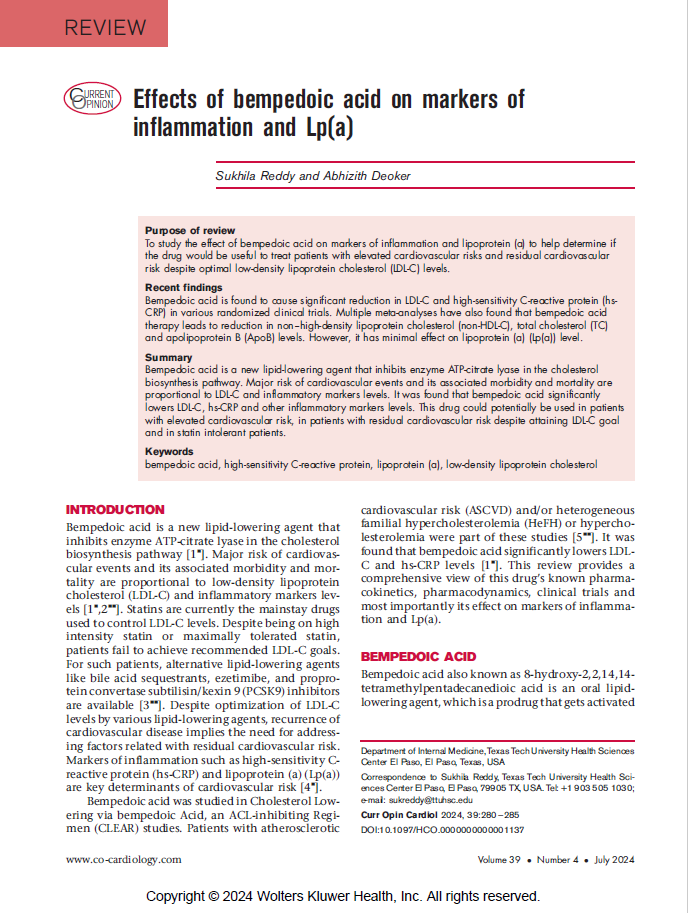
Effects of bempedoic acid on markers of inflammation and Lp(a)

  • Current Opinion in Cardiology
  • July 2024
Hypercholesterolemia Peer-Reviewed Articles

Read Full Article

Abstract

Purpose of review 

To study the effect of bempedoic acid on markers of inflammation and lipoprotein (a) to help determine if the drug would be useful to treat patients with elevated cardiovascular risks and residual cardiovascular risk despite optimal low-density lipoprotein cholesterol (LDL-C) levels.

Recent findings 

Bempedoic acid is found to cause significant reduction in LDL-C and high-sensitivity C-reactive protein (hs-CRP) in various randomized clinical trials. Multiple meta-analyses have also found that bempedoic acid therapy leads to reduction in non–high-density lipoprotein cholesterol (non-HDL-C), total cholesterol (TC) and apolipoprotein B (ApoB) levels. However, it has minimal effect on lipoprotein (a) (Lp(a)) level.

Summary 

Bempedoic acid is a new lipid-lowering agent that inhibits enzyme ATP-citrate lyase in the cholesterol biosynthesis pathway. Major risk of cardiovascular events and its associated morbidity and mortality are proportional to LDL-C and inflammatory markers levels. It was found that bempedoic acid significantly lowers LDL-C, hs-CRP and other inflammatory markers levels. This drug could potentially be used in patients with elevated cardiovascular risk, in patients with residual cardiovascular risk despite attaining LDL-C goal and in statin intolerant patients.

You might also like:

Hypercholesterolemia of Cholestasis

Familial hypercholesterolemia in pregnancy

Triple Versus Dual Lipid-Lowering Therapy in Acute Coronary Syndrome: The ES-BempeDACS Randomized Clinical Trial

APOE and familial hypercholesterolemia

Familial hypercholesterolemia-Plus: is the metabolic syndrome changing the clinical picture of familial hypercholesterolemia?

Case report of familial hypercholesterolemia with internal carotid neck swelling

Share

Modal body text goes here.

FocusOn logo
  • About FocusOn
  • Privacy Policy
  • Terms of Use

© 2026 Wolters Kluwer. All right reserved.

Your Privacy

To give you the best possible experience we use cookies and similar technologies. We use data collected through these technologies for various purposes, including to enhance website functionality, remember your preferences, show the most relevant content, and show the most useful ads. You can select your preferences by clicking the link. For more information, please review our Privacy and Cookie Policy.

|
|

Cookie Policy

Information about our use of cookies

Wolters Kluwer ("we" or "us") wants to inform you about the ways we process your personal information. In this Privacy & Cookie Notice we explain what personal information we collect, use and disclose.

Personal information means any data relating to an individual who can be identified, directly or indirectly, based on that information. This may include information such as names, contact details, (online) identification data, online identifiers, or other characteristics specific to that individual.

Read More