FocusOn Healthcare
  • Women's Health
  • Bone Health
  • Urology
  • Cardiology
  • Head Pain
  • Hepatology
  • Dermatology
  • Gastroenterology
  • Neurology
  • Oncology
  • Specialties:
  • Women's Health
  • Bone Health
  • Urology
  • Cardiology
  • Head Pain
  • Hepatology
  • Dermatology
  • Gastroenterology
  • Neurology
  • Oncology

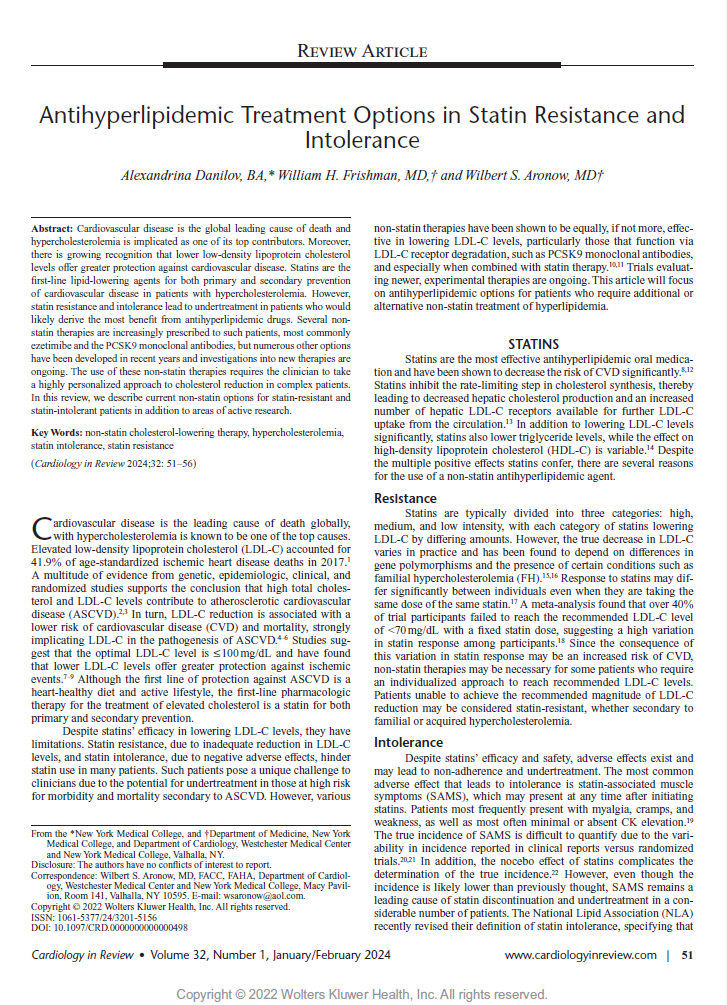
Antihyperlipidemic Treatment Options in Statin Resistance and Intolerance

  • Cardiology in Review
  • February 2024
Hypercholesterolemia Peer-Reviewed Articles

Read Full Article

Abstract

Cardiovascular disease is the global leading cause of death and hypercholesterolemia is implicated as one of its top contributors. Moreover, there is growing recognition that lower low-density lipoprotein cholesterol levels offer greater protection against cardiovascular disease. Statins are the first-line lipid-lowering agents for both primary and secondary prevention of cardiovascular disease in patients with hypercholesterolemia. However, statin resistance and intolerance lead to undertreatment in patients who would likely derive the most benefit from antihyperlipidemic drugs. Several non-statin therapies are increasingly prescribed to such patients, most commonly ezetimibe and the PCSK9 monoclonal antibodies, but numerous other options have been developed in recent years and investigations into new therapies are ongoing. The use of these non-statin therapies requires the clinician to take a highly personalized approach to cholesterol reduction in complex patients. In this review, we describe current non-statin options for statin-resistant and statin-intolerant patients in addition to areas of active research.

You might also like:

Innovative Conjugation Strategies in Atherosclerosis: Charting New Pathways in Lipid-Lowering Therapies From a Pharmacological Perspective

Indications of Bempedoic Acid

Implementation science and genetic testing for familial hypercholesterolemia

Predictors of cardiovascular risk in familial hypercholesterolemia

Coronary artery event-free or resilient familial hypercholesterolemia: what’s in a name?

Psychological determinants and evidence-based behavior change interventions in adherence to therapy for familial hypercholesterolemia

Share

Modal body text goes here.

FocusOn logo
  • About FocusOn
  • Privacy Policy
  • Terms of Use

© 2026 Wolters Kluwer. All right reserved.

Your Privacy

To give you the best possible experience we use cookies and similar technologies. We use data collected through these technologies for various purposes, including to enhance website functionality, remember your preferences, show the most relevant content, and show the most useful ads. You can select your preferences by clicking the link. For more information, please review our Privacy and Cookie Policy.

|
|

Cookie Policy

Information about our use of cookies

Wolters Kluwer ("we" or "us") wants to inform you about the ways we process your personal information. In this Privacy & Cookie Notice we explain what personal information we collect, use and disclose.

Personal information means any data relating to an individual who can be identified, directly or indirectly, based on that information. This may include information such as names, contact details, (online) identification data, online identifiers, or other characteristics specific to that individual.

Read More