FocusOn Healthcare
  • Women's Health
  • Bone Health
  • Urology
  • Cardiology
  • Head Pain
  • Hepatology
  • Dermatology
  • Gastroenterology
  • Neurology
  • Oncology
  • Specialties:
  • Women's Health
  • Bone Health
  • Urology
  • Cardiology
  • Head Pain
  • Hepatology
  • Dermatology
  • Gastroenterology
  • Neurology
  • Oncology

Indications of Bempedoic Acid

  • Cardiology in Review
  • December 2025
Hypercholesterolemia Peer-Reviewed Articles

Read Full Article

Abstract

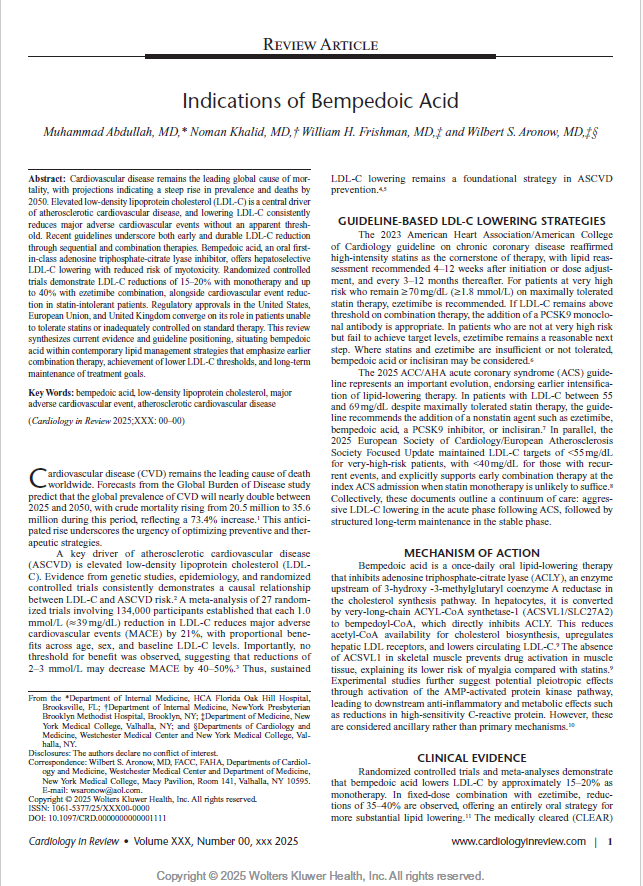
Cardiovascular disease remains the leading global cause of mortality, with projections indicating a steep rise in prevalence and deaths by 2050. Elevated low-density lipoprotein cholesterol (LDL-C) is a central driver of atherosclerotic cardiovascular disease, and lowering LDL-C consistently reduces major adverse cardiovascular events without an apparent threshold. Recent guidelines underscore both early and durable LDL-C reduction through sequential and combination therapies. Bempedoic acid, an oral first-in-class adenosine triphosphate-citrate lyase inhibitor, offers hepatoselective LDL-C lowering with reduced risk of myotoxicity. Randomized controlled trials demonstrate LDL-C reductions of 15–20% with monotherapy and up to 40% with ezetimibe combination, alongside cardiovascular event reduction in statin-intolerant patients. Regulatory approvals in the United States, European Union, and United Kingdom converge on its role in patients unable to tolerate statins or inadequately controlled on standard therapy. This review synthesizes current evidence and guideline positioning, situating bempedoic acid within contemporary lipid management strategies that emphasize earlier combination therapy, achievement of lower LDL-C thresholds, and long-term maintenance of treatment goals.

You might also like:

Innovative Conjugation Strategies in Atherosclerosis: Charting New Pathways in Lipid-Lowering Therapies From a Pharmacological Perspective

Antihyperlipidemic Treatment Options in Statin Resistance and Intolerance

Implementation science and genetic testing for familial hypercholesterolemia

Predictors of cardiovascular risk in familial hypercholesterolemia

Coronary artery event-free or resilient familial hypercholesterolemia: what’s in a name?

Psychological determinants and evidence-based behavior change interventions in adherence to therapy for familial hypercholesterolemia

Share

Modal body text goes here.

FocusOn logo
  • About FocusOn
  • Privacy Policy
  • Terms of Use

© 2026 Wolters Kluwer. All right reserved.

Your Privacy

To give you the best possible experience we use cookies and similar technologies. We use data collected through these technologies for various purposes, including to enhance website functionality, remember your preferences, show the most relevant content, and show the most useful ads. You can select your preferences by clicking the link. For more information, please review our Privacy and Cookie Policy.

|
|

Cookie Policy

Information about our use of cookies

Wolters Kluwer ("we" or "us") wants to inform you about the ways we process your personal information. In this Privacy & Cookie Notice we explain what personal information we collect, use and disclose.

Personal information means any data relating to an individual who can be identified, directly or indirectly, based on that information. This may include information such as names, contact details, (online) identification data, online identifiers, or other characteristics specific to that individual.

Read More