FocusOn Healthcare
  • Women's Health
  • Bone Health
  • Urology
  • Cardiology
  • Head Pain
  • Hepatology
  • Dermatology
  • Endocrinology
  • Gastroenterology
  • Neurology
  • Oncology
  • Specialties:
  • Women's Health
  • Bone Health
  • Urology
  • Cardiology
  • Head Pain
  • Hepatology
  • Dermatology
  • Endocrinology
  • Gastroenterology
  • Neurology
  • Oncology

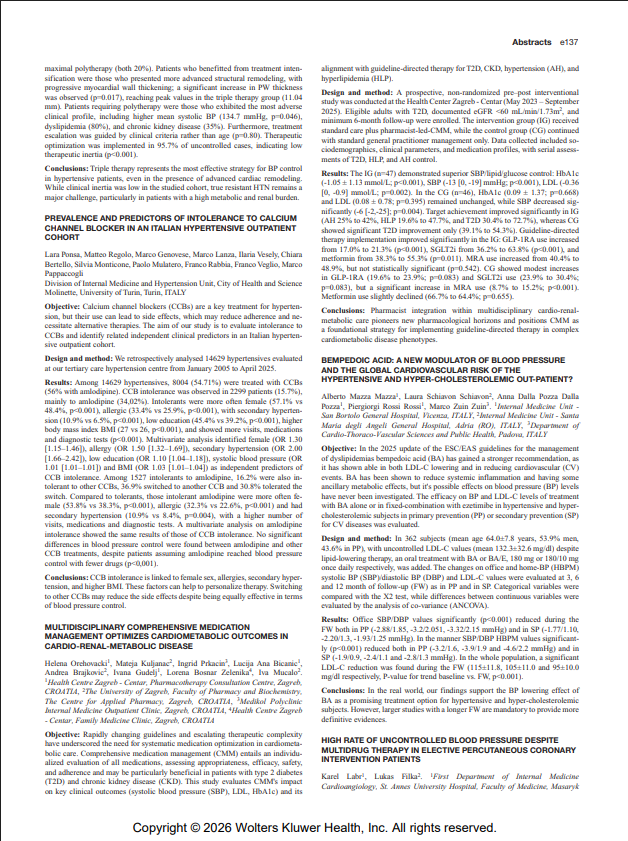
BEMPEDOIC ACID: A NEW MODULATOR OF BLOOD PRESSURE AND THE GLOBAL CARDIOVASCULAR RISK OF THE HYPERTENSIVE AND HYPER-CHOLESTEROLEMIC OUT-PATIENT?

  • Journal of Hypertension
  • May 2026
Hypercholesterolemia Peer-Reviewed Articles

Read Full Article

Objective:

In the 2025 update of the ESC/EAS guidelines for the management of dyslipidemias bempedoic acid (BA) has gained a stronger recommendation, as it has shown able in both LDL-C lowering and in reducing cardiovascular (CV) events. BA has been shown to reduce systemic inflammation and having some ancillary metabolic effects, but it's possible effects on blood pressure (BP) levels have never been investigated. The efficacy on BP and LDL-C levels of treatment with BA alone or in fixed-combination with ezetimibe in hypertensive and hyper-cholesterolemic subjects in primary prevention (PP) or secondary prevention (SP) for CV diseases was evaluated.

Design and method:

In 362 subjects (mean age 64.0±7.8 years, 53.9% men, 43.6% in PP), with uncontrolled LDL-C values (mean 132.3±32.6 mg/dl) despite lipid-lowering therapy, an oral treatment with BA or BA/E, 180 mg or 180/10 mg once daily respectively, was added. The changes on office and home-BP (HBPM) systolic BP (SBP)/diastolic BP (DBP) and LDL-C values were evaluated at 3, 6 and 12 month of follow-up (FW) as in PP and in SP. Categorical variables were compared with the X2 test, while differences between continuous variables were evaluated by the analysis of co-variance (ANCOVA).

Results:

Office SBP/DBP values significantly (p<0.001) reduced during the FW both in PP (-2.88/1.85, -3.2/2.051, -3.32/2.15 mmHg) and in SP (-1.77/1.10, -2.20/1.3, -1.93/1.25 mmHg). In the manner SBP/DBP HBPM values significantly (p<0.001) reduced both in PP (-3.2/1.6, -3.9/1.9 and -4.6/2.2 mmHg) and in SP (-1.9/0.9, -2.4/1.1 and -2.8/1.3 mmHg). In the whole population, a significant LDL-C reduction was found during the FW (115±11.8, 105±11.0 and 95±10.0 mg/dl respectively, P-value for trend baseline vs. FW, p<0.001).

Conclusions:

In the real world, our findings support the BP lowering effect of BA as a promising treatment option for hypertensive and hyper-cholesterolemic subjects. However, larger studies with a longer FW are mandatory to provide more definitive evidences.

You might also like:

Hypercholesterolemia of Cholestasis

Familial hypercholesterolemia in pregnancy

Triple Versus Dual Lipid-Lowering Therapy in Acute Coronary Syndrome: The ES-BempeDACS Randomized Clinical Trial

Effects of bempedoic acid on markers of inflammation and Lp(a)

Bempedoic acid: a new player for statin-intolerant patients and beyond

Advancements in lipid-lowering therapy: the role of proprotein convertase subtilisin/kexin type 9 inhibitors and beyond in cardiovascular risk reduction

Pleiotropic effects of bempedoic acid on endothelial function and arterial stiffness: a preliminary study

Lower LDL-C, lower risk of recurrent cardiovascular events in stroke survivors

Discontinuation of statin therapy – an updated review

Polygenic Prediction of Nongoal Response to Statin Therapy

Bempedoic Acid and First and Recurrent Limb Outcomes in Statin-Intolerant Patients With Peripheral Artery Disease: Insights From the CLEAR Outcomes Trial

APOE and familial hypercholesterolemia

Familial hypercholesterolemia-Plus: is the metabolic syndrome changing the clinical picture of familial hypercholesterolemia?

Case report of familial hypercholesterolemia with internal carotid neck swelling

Share

Modal body text goes here.

FocusOn logo
  • About FocusOn
  • Privacy Policy
  • Terms of Use

© 2026 Wolters Kluwer. All right reserved.

Your Privacy

To give you the best possible experience we use cookies and similar technologies. We use data collected through these technologies for various purposes, including to enhance website functionality, remember your preferences, show the most relevant content, and show the most useful ads. You can select your preferences by clicking the link. For more information, please review our Privacy and Cookie Policy.

|
|

Cookie Policy

Information about our use of cookies

Wolters Kluwer ("we" or "us") wants to inform you about the ways we process your personal information. In this Privacy & Cookie Notice we explain what personal information we collect, use and disclose.

Personal information means any data relating to an individual who can be identified, directly or indirectly, based on that information. This may include information such as names, contact details, (online) identification data, online identifiers, or other characteristics specific to that individual.

Read More