Bempedoic Acid and First and Recurrent Limb Outcomes in Statin-Intolerant Patients With Peripheral Artery Disease: Insights From the CLEAR Outcomes Trial
- August 2026
BACKGROUND:
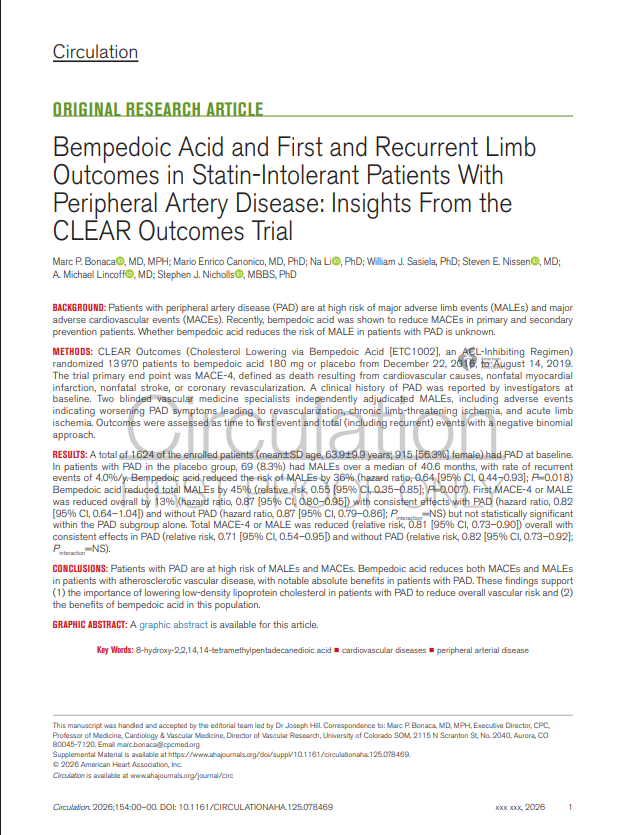
Patients with peripheral artery disease (PAD) are at high risk of major adverse limb events (MALEs) and major adverse cardiovascular events (MACEs). Recently, bempedoic acid was shown to reduce MACEs in primary and secondary prevention patients. Whether bempedoic acid reduces the risk of MALE in patients with PAD is unknown.
METHODS:
CLEAR Outcomes (Cholesterol Lowering via Bempedoic Acid [ETC1002], an ACL-Inhibiting Regimen) randomized 13 970 patients to bempedoic acid 180 mg or placebo from December 22, 2016, to August 14, 2019. The trial primary end point was MACE-4, defined as death resulting from cardiovascular causes, nonfatal myocardial infarction, nonfatal stroke, or coronary revascularization. A clinical history of PAD was reported by investigators at baseline. Two blinded vascular medicine specialists independently adjudicated MALEs, including adverse events indicating worsening PAD symptoms leading to revascularization, chronic limb-threatening ischemia, and acute limb ischemia. Outcomes were assessed as time to first event and total (including recurrent) events with a negative binomial approach.
RESULTS:
A total of 1624 of the enrolled patients (mean±SD age, 63.9±9.9 years; 915 [56.3%] female) had PAD at baseline. In patients with PAD in the placebo group, 69 (8.3%) had MALEs over a median of 40.6 months, with rate of recurrent events of 4.0%/y. Bempedoic acid reduced the risk of MALEs by 36% (hazard ratio, 0.64 [95% CI, 0.44–0.93]; P=0.018) Bempedoic acid reduced total MALEs by 45% (relative risk, 0.55 [95% CI, 0.35–0.85]; P=0.007). First MACE-4 or MALE was reduced overall by 13% (hazard ratio, 0.87 [95% CI, 0.80–0.95]) with consistent effects with PAD (hazard ratio, 0.82 [95% CI, 0.64–1.04]) and without PAD (hazard ratio, 0.87 [95% CI, 0.79–0.86]; Pinteraction=NS) but not statistically significant within the PAD subgroup alone. Total MACE-4 or MALE was reduced (relative risk, 0.81 [95% CI, 0.73–0.90]) overall with consistent effects in PAD (relative risk, 0.71 [95% CI, 0.54–0.95]) and without PAD (relative risk, 0.82 [95% CI, 0.73–0.92]; Pinteraction=NS).
CONCLUSIONS:
Patients with PAD are at high risk of MALEs and MACEs. Bempedoic acid reduces both MACEs and MALEs in patients with atherosclerotic vascular disease, with notable absolute benefits in patients with PAD. These findings support (1) the importance of lowering low-density lipoprotein cholesterol in patients with PAD to reduce overall vascular risk and (2) the benefits of bempedoic acid in this population.
You might also like:

© 2026 Wolters Kluwer. All right reserved.