FocusOn Healthcare
  • Women's Health
  • Bone Health
  • Urology
  • Cardiology
  • Head Pain
  • Hepatology
  • Dermatology
  • Endocrinology
  • Gastroenterology
  • Neurology
  • Oncology
  • Specialties:
  • Women's Health
  • Bone Health
  • Urology
  • Cardiology
  • Head Pain
  • Hepatology
  • Dermatology
  • Endocrinology
  • Gastroenterology
  • Neurology
  • Oncology

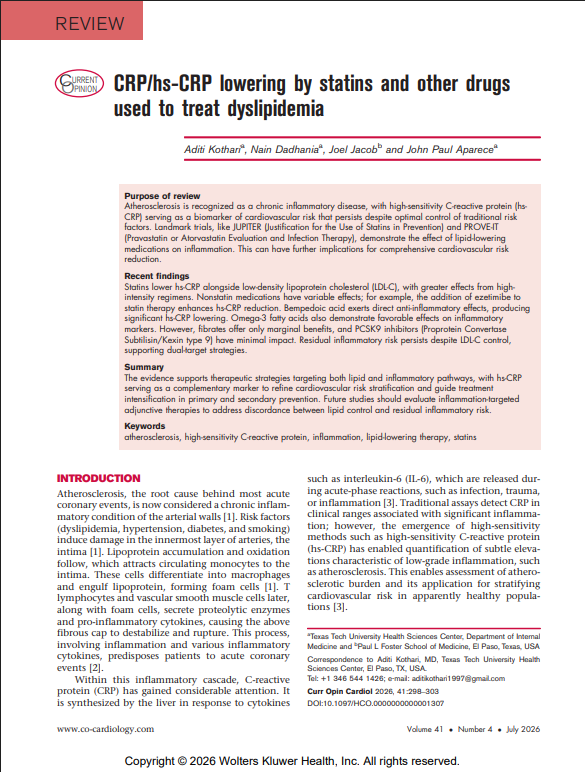
CRP/hs-CRP lowering by statins and other drugs used to treat dyslipidemia

  • Aug 2026
Hypercholesterolemia Peer-Reviewed Articles

Read Full Article

Purpose of review

Atherosclerosis is recognized as a chronic inflammatory disease, with high-sensitivity C-reactive protein (hs-CRP) serving as a biomarker of cardiovascular risk that persists despite optimal control of traditional risk factors. Landmark trials, like JUPITER (Justification for the Use of Statins in Prevention) and PROVE-IT (Pravastatin or Atorvastatin Evaluation and Infection Therapy), demonstrate the effect of lipid-lowering medications on inflammation. This can have further implications for comprehensive cardiovascular risk reduction.

Recent findings

Statins lower hs-CRP alongside low-density lipoprotein cholesterol (LDL-C), with greater effects from high-intensity regimens. Nonstatin medications have variable effects; for example, the addition of ezetimibe to statin therapy enhances hs-CRP reduction. Bempedoic acid exerts direct anti-inflammatory effects, producing significant hs-CRP lowering. Omega-3 fatty acids also demonstrate favorable effects on inflammatory markers. However, fibrates offer only marginal benefits, and PCSK9 inhibitors (Proprotein Convertase Subtilisin/Kexin type 9) have minimal impact. Residual inflammatory risk persists despite LDL-C control, supporting dual-target strategies.

Summary

The evidence supports therapeutic strategies targeting both lipid and inflammatory pathways, with hs-CRP serving as a complementary marker to refine cardiovascular risk stratification and guide treatment intensification in primary and secondary prevention. Future studies should evaluate inflammation-targeted adjunctive therapies to address discordance between lipid control and residual inflammatory risk.

You might also like:

Indications of Bempedoic Acid

Antihyperlipidemic Treatment Options in Statin Resistance and Intolerance

Efficacy and Safety of ETC-1002, a Novel Investigational Low-Density Lipoprotein-Cholesterol–Lowering Therapy for the Treatment of Patients With Hypercholesterolemia and Type 2 Diabetes Mellitus

Bempedoic acid LDL-C lowering without adverse reactions

Implementation science and genetic testing for familial hypercholesterolemia

Predictors of cardiovascular risk in familial hypercholesterolemia

Coronary artery event-free or resilient familial hypercholesterolemia: what’s in a name?

Psychological determinants and evidence-based behavior change interventions in adherence to therapy for familial hypercholesterolemia

Share

Modal body text goes here.

FocusOn logo
  • About FocusOn
  • Privacy Policy
  • Terms of Use

© 2026 Wolters Kluwer. All right reserved.

Your Privacy

To give you the best possible experience we use cookies and similar technologies. We use data collected through these technologies for various purposes, including to enhance website functionality, remember your preferences, show the most relevant content, and show the most useful ads. You can select your preferences by clicking the link. For more information, please review our Privacy and Cookie Policy.

|
|

Cookie Policy

Information about our use of cookies

Wolters Kluwer ("we" or "us") wants to inform you about the ways we process your personal information. In this Privacy & Cookie Notice we explain what personal information we collect, use and disclose.

Personal information means any data relating to an individual who can be identified, directly or indirectly, based on that information. This may include information such as names, contact details, (online) identification data, online identifiers, or other characteristics specific to that individual.

Read More